New York City, New York, USA: Zohran Mamdani has made history in New York City, securing over one million votes and setting a new record for the largest vote share ever achieved by a first-time mayoral candidate in the city’s history.
Blending socialist ideals with the energy of Bollywood, the 34-year-old Democratic Socialist triumphed in the November 4 election to become New York’s newest mayor — and notably, the city’s first Indian-American, first Muslim, and youngest mayor in more than 100 years.
Mamdani’s victory came after defeating two high-profile rivals: former governor Andrew Cuomo, who ran as an independent with support from Donald Trump, and Republican candidate Curtis Sliwa. What began as a grassroots effort in Queens soon evolved into a citywide cultural movement that reshaped New York’s political narrative.
“Dhoom Machale” Marks a Historic Night
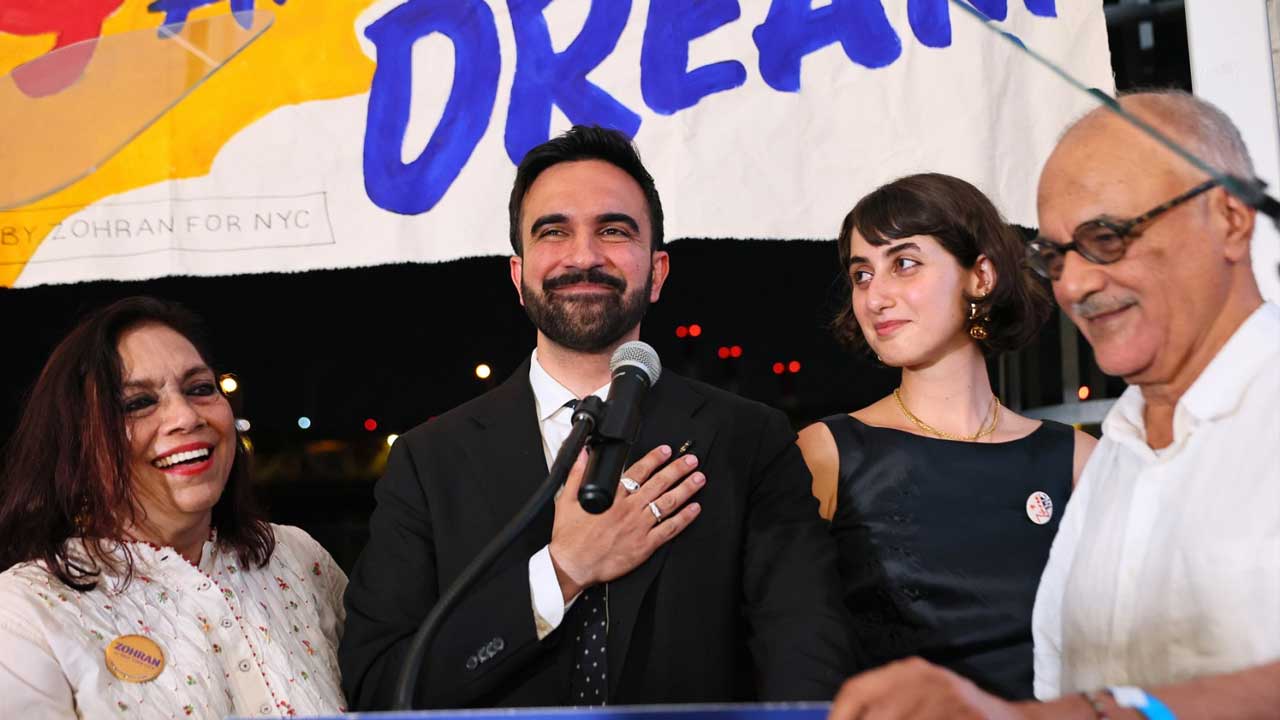
During his victory celebration in Brooklyn, Mamdani ended his speech to the tune of “Dhoom Machale”, the iconic 2004 Bollywood anthem. The moment turned jubilant as supporters danced and waved New York City flags while the music filled the hall.
Standing beside him were his wife, animator Rama Duwaji, and his parents — acclaimed filmmaker Mira Nair and scholar Mahmood Mamdani. Expressing gratitude to his campaign volunteers, Mamdani reiterated his central pledges: affordable housing, free public bus services, universal childcare, and halting rent hikes.
In his remarks, which referenced India’s first Prime Minister Jawaharlal Nehru, Mamdani emphasised his vision of “a city where working families can afford to live and thrive.”
Clips of the celebration quickly went viral online. “Zohran Mamdani closing his mayoral victory speech with Dhoom Machale — feels straight out of a film,” wrote one X user. Another commented, “We need a montage of Zohran walking through NYC to that background track.”
For many, the spectacle represented more than a celebration — it symbolised how immigrant identity and popular culture are reshaping the landscape of American politics.
Bollywood Becomes a Campaign Language
Mamdani’s campaign strategically used Bollywood references to communicate complex political ideas in a relatable way. His team produced social media clips parodying iconic film moments to explain policies and civic issues.
In one viral reel, he recreated Amitabh Bachchan’s famous Deewar scene — changing “Mere paas maa hai” to “Mere paas aap ho” (“I have you”). Another campaign video used a Kishore Kumar song from Karz to simplify ranked-choice voting for younger audiences.
His slogan, “Ab, aapka time aagaya” (“Now, your time has come”), borrowed inspiration from Gully Boy’s “Apna Time Aayega.” Posters and digital banners adopted the bold, colourful typography of classic Hindi cinema, while campaign rallies across Queens featured multilingual addresses and South Asian music.
According to campaign data, Mamdani saw a significant surge in support among voters under 35, especially within South Asian and Latino communities.
Bridging Culture and Politics
Throughout the campaign, Mamdani consistently tied his South Asian background to themes of labour rights, inclusivity, and immigrant representation. In one lighthearted video, he discussed Islamophobia while enjoying biryani and haleem — a scene his critics mocked, but his campaign described as “a gesture of normalising immigrant identity in American public life.”
Election materials were distributed in English, Hindi, Urdu, and Bengali. In several Queens neighbourhoods, posters read: “Amar mayor, Tomar mayor, Mamdani Mamdani!” (“My mayor, Your mayor, Mamdani Mamdani!”).
Political observers credited this multilingual strategy with turning cultural pride into civic engagement. Analyst Rina Desai told The Hindu that Mamdani “translated progressive politics into the language of local culture.”
When he officially takes office on January 1, 2026, Mamdani will inherit major challenges — including rising living costs, a severe housing crunch, and the need for better public transportation. His proposed policies, such as rent freezes, free bus services, and expanded childcare, will require strong collaboration with the City Council and New York State legislators.