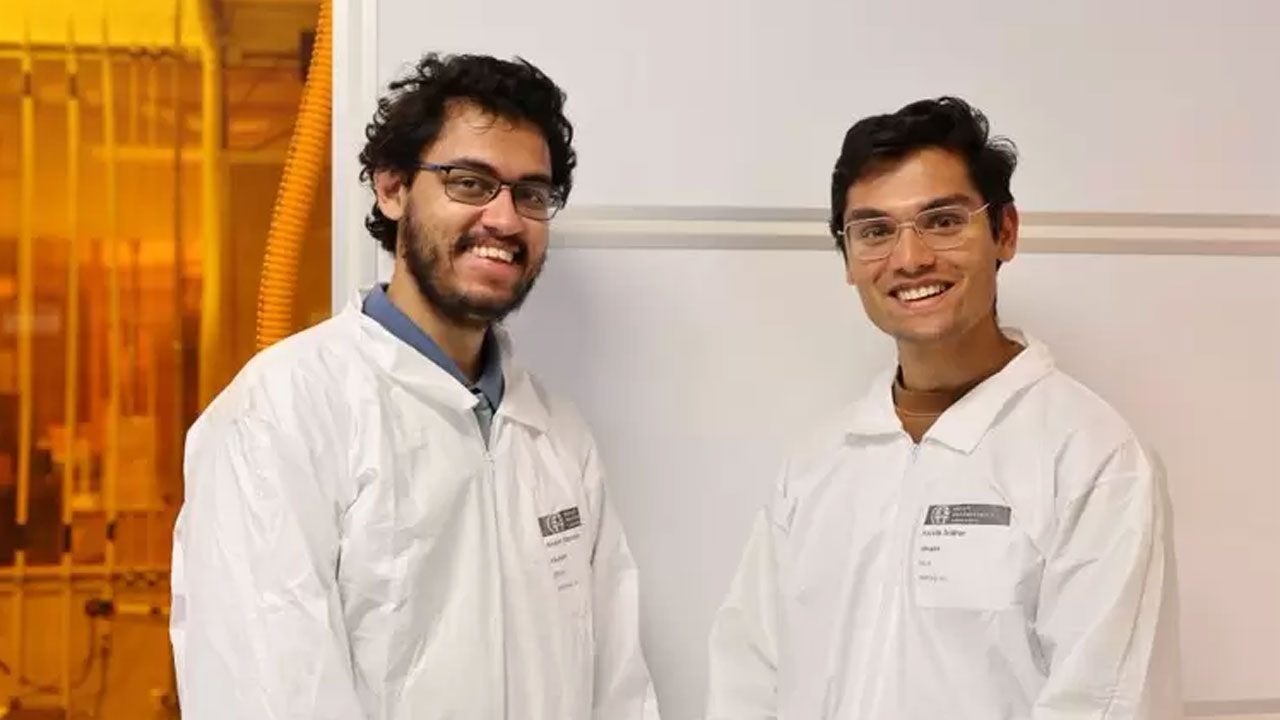
San Francisco, California, USA: Two IIT Madras alumni, Advaith Sridhar and Akash Ramdas, have raised $9 million in seed funding for their San Francisco-based deep-tech startup, Discovered Materials. The company is focused on addressing one of the semiconductor industry's key challenges: thermal management.
The funding round was led by Lightspeed India Partners, with participation from Y Combinator, Peak XV Partners and prominent global angel investors, including YC co-founder Paul Graham, Gokul Rajaram and Thariq Shihipar.
Alongside the funding announcement, Discovered Materials released hundreds of new materials discovered using frontier AI models and introduced the Material Discovery Bench, a benchmark designed to track progress in AI-driven material discovery.
The company said the new funding will help accelerate its mission of making material discovery fast enough to keep pace with the growing demand for computing power driven by artificial intelligence.
Announcing the funding on X, Advaith Sridhar said Discovered Materials is building AI scientists capable of discovering new materials for semiconductor chips. He also announced the release of hundreds of materials identified using frontier AI models, along with the Material Discovery Bench.
According to Sridhar, heat has become a major bottleneck for semiconductor chips, limiting further improvements in performance and efficiency. He said new materials could help overcome these limitations and enable significant advances in chip design.
He specifically highlighted the potential of thermally conductive dielectric materials, which could enable 3D packaging of logic and memory and potentially make chips up to 10 times more energy efficient. Other components of AI chips, including substrates, interconnects and transistors, could also require new materials to achieve further performance improvements.
The Material Discovery Bench provides frontier AI models with an open-ended material discovery challenge focused on finding new dielectric materials for semiconductor chips.
The models are given access to resources comparable to those available to a capable PhD student, including atomistic simulation software, coding environments, property prediction models and web search. Each model run is designed as a long-horizon task, with models allowed to make unlimited submissions during the run.
Sridhar said models including Sol, Fable, Opus and Kimi-3 have demonstrated significant capabilities in the task, generating hundreds of unique materials that are stable and show promising thermal, dielectric and mechanical properties.
However, he noted that discovering a material is only the first step. Developing a practical method to manufacture the material in a laboratory remains a major challenge in the field.
Of the more than 500 new materials discovered by the models, Sridhar said only one, discovered by Sol, currently has a plausible synthesis route.
Investor and technology executive Gokul Rajaram also expressed his support for the Discovered Materials team, saying he was excited about the potential of Advaith Sridhar, Akash Ramdas and the company to transform the way semiconductor chips are developed.
Rajaram also highlighted the growing thermal limitations faced by AI chips. As chip performance continues to increase, managing the heat generated by increasingly powerful processors has become an important physical constraint.
He said advances in materials, particularly thermally conductive dielectric materials, could significantly improve chip performance and energy efficiency while supporting advanced 3D packaging technologies.