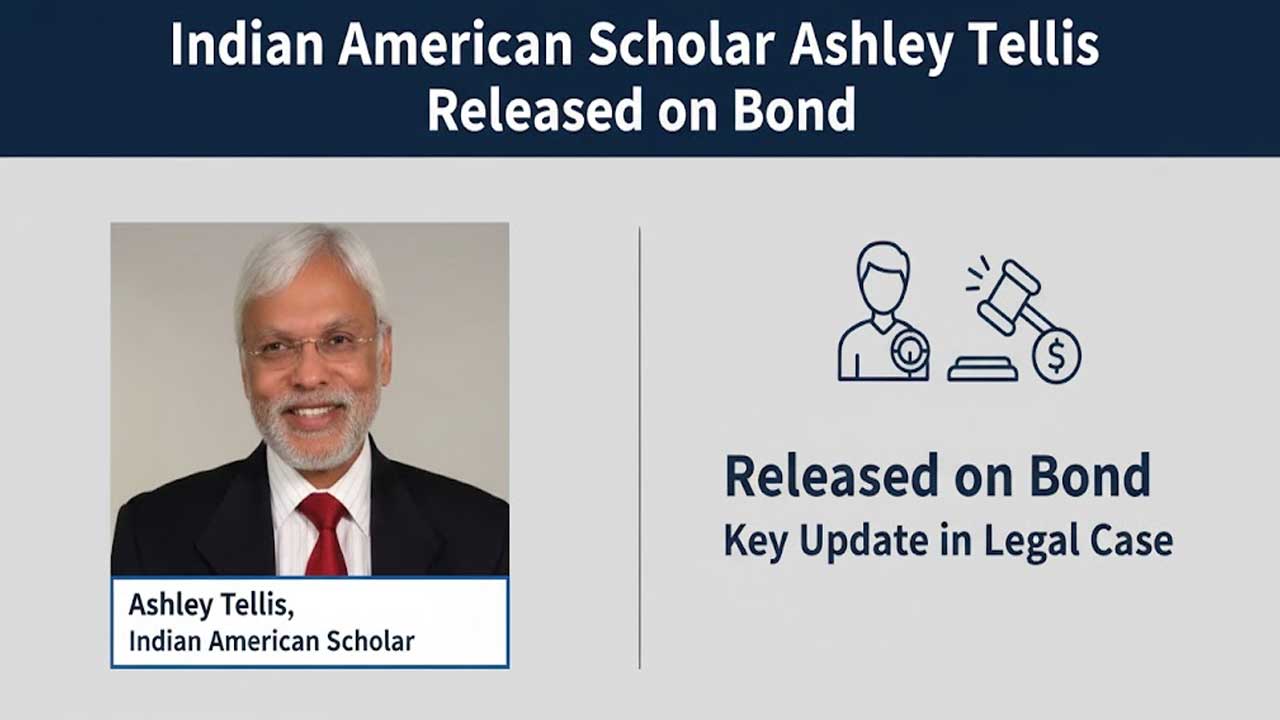
Richmond, Virginia, USA: Ashley J. Tellis, an Indian-born scholar and senior fellow at the Carnegie Endowment for International Peace, was granted release on a personal recognisance bond on October 21 after being charged with unlawfully keeping classified national defence materials. Tellis has been recognised as a leading voice on Asian security matters in Washington.
The 64-year-old expert, who previously held senior positions at the State Department, the Department of Defence, and the White House during George W. Bush’s presidency, was taken into custody on October 11. The arrest followed an FBI probe that reportedly uncovered over 1,000 pages of documents labelled Secret and Top Secret at his Vienna, Virginia, residence.
Tellis appeared in court before U.S. Magistrate Judge Lindsey Robinson Vaala of the Eastern District of Virginia. The judge allowed his release under strict conditions, including the surrender of his passport, travel limits within the Washington D.C. metro area, and oversight by pretrial services. His wife, Dhun Tellis, co-signed a $1.5 million secured bond backed by their home.
Justice Department Accusations
The Department of Justice stated that Tellis “removed over a thousand pages of classified national defence information from government facilities and stored them at his home.” Prosecutors claim that while holding Top Secret clearance with Sensitive Compartmented Information (SCI) access, Tellis printed, modified, and concealed classified documents from secure systems at both the State Department and the Pentagon’s Office of Net Assessment.
Principal Deputy Assistant Attorney General Sue J. Bai described the matter as “a serious breach of trust,” emphasising that protecting national defence information remains a critical priority. FBI officials labelled the arrest as “a warning to anyone considering compromising national security,” noting that the search was conducted under a court-authorised warrant to prevent sensitive defence information from reaching unauthorised individuals.
Defence Argues Misinterpretation of Routine Academic Work
Represented by attorneys John Nassikas and Deborah Curtis of Arnold & Porter, Tellis’ defence rejected the government’s allegations. In a 14-page filing, they claimed that the authorities “misread routine professional responsibilities, including liaison work and travel abroad, as covert activity.” They highlighted that Tellis’s interactions with foreign diplomats, including Chinese officials, were entirely lawful and aligned with his professional duties as a policy expert.
The lawyers also addressed a “red gift bag” flagged by the FBI, clarifying that it contained a modest gift of tea—a common courtesy in diplomatic and academic circles. “Interpreting this as something nefarious is without basis,” the filing stated.
The defence argued that Tellis, a U.S. citizen with a PhD and strong family, professional, and community connections, “poses no risk of fleeing.” They also pointed to his long record of public service, including advising on the U.S.-India civil nuclear deal and multiple national security initiatives.
Court Proceedings
During his initial court appearance on October 14 before Magistrate Judge John F. Anderson, prosecutors initially requested detention. However, they later consented to conditional release while the case proceeds. On October 21, Tellis waived his right to a preliminary hearing, and Judge Vaala approved his bond with requirements for ongoing cooperation and pretrial supervision.
The case has been postponed to December 10, 2025, after Judge Leonie Brinkema granted a joint request to extend the indictment deadline, citing the Speedy Trial Act’s provisions for “the ends of justice.”
Background
Born in India, Tellis has long been a key figure in U.S. discussions on Asian security. Over four decades, he has authored more than 20 books and bridged academia and policymaking. His recent work, Striking Asymmetries: Nuclear Transitions in Southern Asia, examines nuclear competition between China, India, and Pakistan.
Legal Considerations
Tellis faces potential charges under 18 U.S.C. 793(e) of the Espionage Act, which addresses the unauthorised retention of national defence information. No claims have been made regarding sharing or transmitting the documents, and his defence noted that pretrial detention in retention-only cases is rare.
A DOJ spokesperson emphasised that the criminal complaint is “only an allegation” and reiterated that Tellis “is presumed innocent until proven guilty beyond a reasonable doubt.”