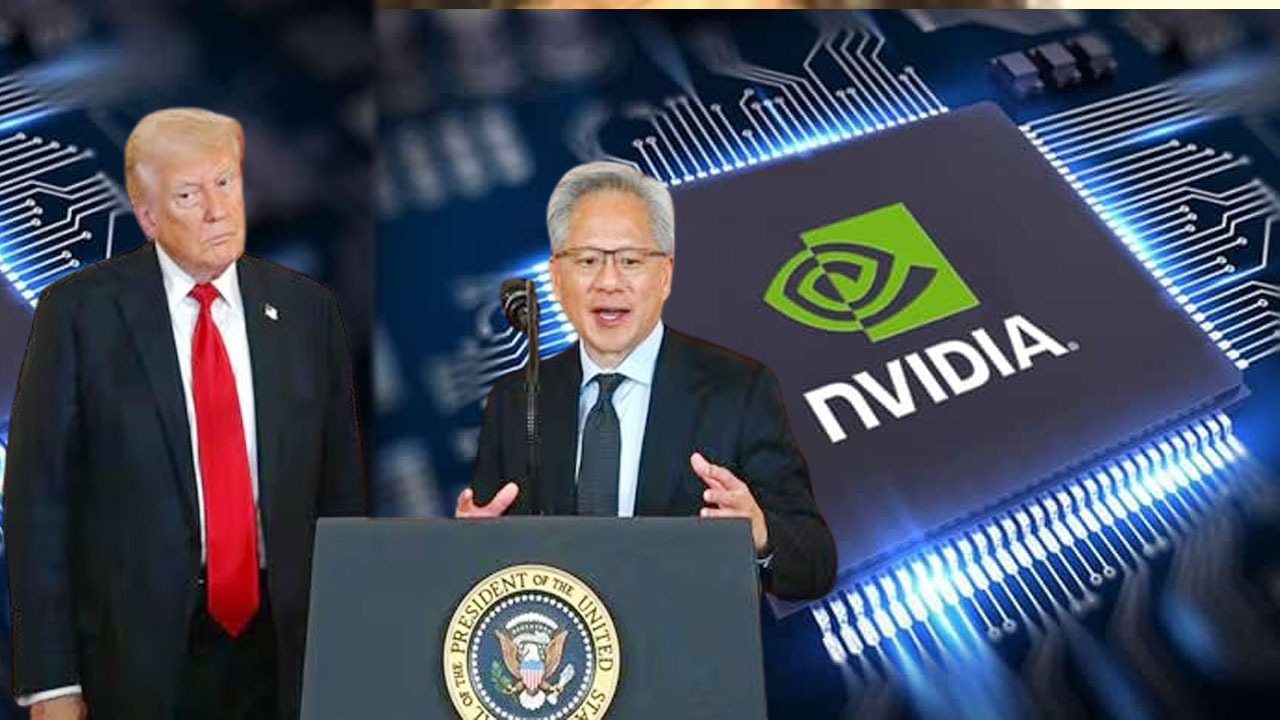
Washington, D.C., USA: Trump Clears Nvidia to Supply H200 AI Chips to China With an Added 25% Fee
Former President Donald Trump has authorised Nvidia Corp. to export its H200 artificial intelligence processors to China, on the condition that each shipment carries a 25% surcharge. The approval gives the world’s most valuable tech company a path to recover major revenue losses from one of its most important international markets.
Trump revealed the decision on his Truth Social platform after weeks of discussions with his advisers. He said he notified Chinese President Xi Jinping, who reportedly reacted positively. According to Trump, only “approved buyers” in China will receive the chips, and rival companies like Intel Corp. and Advanced Micro Devices Inc. will also be permitted to sell under similar conditions.
The approval marks a major win for Nvidia, which has been urging the Trump administration and US lawmakers to ease strict export rules that previously prevented the firm from sending its AI hardware to the world’s largest semiconductor market. Nvidia CEO Jensen Huang, who has strengthened his relationship with Trump since the 2024 election, has repeatedly argued that heavy restrictions only strengthen local Chinese competitors such as Huawei Technologies Co.
However, Trump’s decision drew immediate criticism from Democratic lawmakers, including Senator Elizabeth Warren, who warned that giving China access to advanced AI components could become a major economic and security mistake. The H200 chip is considered significantly more capable than any processor currently available to Chinese manufacturers like Huawei, Cambricon Technologies, or Moore Threads. China’s domestic supply also remains short of meeting national demand. Still, Beijing has historically discouraged major state-linked entities from using Nvidia products as part of its push to reduce reliance on US technology.
Trump defended the decision, saying the arrangement would safeguard US national interests while supporting American jobs and maintaining the country's leadership in artificial intelligence. He noted that Nvidia’s newer Blackwell and Rubin chip families—intended for American customers—are not included in the deal. Bloomberg previously reported that the administration was weighing the H200 approval.
According to a Commerce Department official, the 25% payment to the US government will be collected as a tariff when chips manufactured in Taiwan are sent to the United States for inspection by the Bureau of Industry and Security. After the security check, they will be forwarded to authorized clients in China.
Nvidia praised the move, stating that offering the H200 to vetted commercial buyers “supports well-paid American manufacturing jobs” and represents a balanced solution. Intel, AMD, and Commerce Department representatives declined to comment, while Chinese officials did not provide an immediate response.
Following Trump’s announcement, shares of Nvidia and AMD rose around 2% in after-hours trading, while Intel gained less than 1%.
Analysts say the approval marks the most significant shift yet in Washington’s policy on technology exports to China—and could reshape China’s AI development path. In exchange for the revenue share, the US will allow sales of a chip more powerful than anything China can currently import legally.
But some experts warn the move could empower Chinese AI developers such as DeepSeek. Chris McGuire, a senior fellow at the Council on Foreign Relations and a former National Security Council official, argued that the decision weakens US leverage at a time when China is increasing economic pressure on the US.
During meetings with Trump earlier in the week, Nvidia’s Jensen Huang admitted uncertainty over whether China would accept the H200 if restrictions were loosened, saying Chinese buyers do not want downgraded versions of US chips.
In August, Nvidia received approval to sell its H20 chip in China, while AMD secured clearance for its MI308 model—both engineered to comply with older export limits. Under that plan, companies would have paid 15% of their China sales to the US, but the policy was never fully implemented, so no payments occurred.
Both the H20 and H200 are part of Nvidia’s aging Hopper architecture. Meanwhile, Nvidia’s US market has already moved on to the more advanced Blackwell line, with an even faster generation named Rubin on the way. Despite being based on an older platform, the H200 still offers nearly ten times the performance previously allowed for export to China, according to research by Georgetown University’s Center for Security and Emerging Technology.
Past attempts to sell the H20 to China were obstructed by Beijing, which instructed domestic organizations to prioritize Chinese-made chips instead of purchasing from US brands. This effectively blocked Nvidia and AMD from operating in the world's largest semiconductor consumer market.
Trump had previously mentioned the idea of allowing a limited version of Nvidia’s Blackwell chips for China ahead of his meeting with Xi. However, the subject did not surface during their talks in South Korea. Key cabinet members, including US Trade Representative Jamieson Greer and Treasury Secretary Scott Bessent, later stated they opposed exporting Blackwell chips to China at this stage.
Huang has estimated China could be a $50 billion market for Nvidia, although the company currently excludes China-based data centre sales from its financial projections. He has repeatedly expressed interest in reconnecting with Chinese buyers.
Meanwhile, Nvidia recently secured a legislative victory when Congress removed a proposal—the GAIN AI Act—from a major defence bill. The act would have forced chipmakers to prioritize supplying US buyers before selling to China or other restricted countries.
The US shift in export strategy represents a dramatic turn from rules first implemented in 2022 to prevent China’s military from gaining access to top-tier American technology. The H200, designed for both training and operating AI models, has strengthened calls from lawmakers pushing for the SAFE Act—new legislation intended to enshrine current US export restrictions on advanced chips sent to China.