Hong Kong, China: Every year on August 29, Telugu Language Day is observed to honor the birth anniversary of Gidugu Ramamurthy, a pioneering figure in the development and modernization of the Telugu language. Both government and private educational institutions organize a variety of programs to mark this important occasion.
Gidugu Ramamurthy’s Contributions to the Telugu Language
Gidugu Ramamurthy Pantulu is widely recognized as the father of the Vyavaharika Bhasha movement, which promoted the use of the spoken vernacular in Telugu. Some of his notable works include:
- “Telugu Grammar Criticism” – An analytical study of grammatical nuances in Telugu.
- “Andhra Pandita Bhishakulu” – Essays on reforming and simplifying the Telugu language.
- “Simple Vyavaharika Language Experiment” – Discussion on the importance of adopting a practical, everyday Telugu for education.
Core Principles of His Work
- “The spoken language should be written; the written language should speak.”
- “Language for the people; the people’s language is the real language.”
- “Colloquial language should be used in education instead of complex grammatical forms.”
Language Reforms Initiated by Him
- Introducing vernacular Telugu in schools
- Promoting easy-to-understand Telugu through practical experiments
- Simplifying difficult vocabulary for better comprehension
Major Books by Gidugu Ramamurthy
- Social Linguistics
- Development of Andhra Language
- Pragmatic Linguistics
Philosophy on Language Evolution
According to Gidugu, language must evolve according to the needs of the people. A living language, understood by common people, is the most effective medium for education. His ideas on language reform continue to guide the development and modernization of Telugu today.
Celebrations in Hong Kong
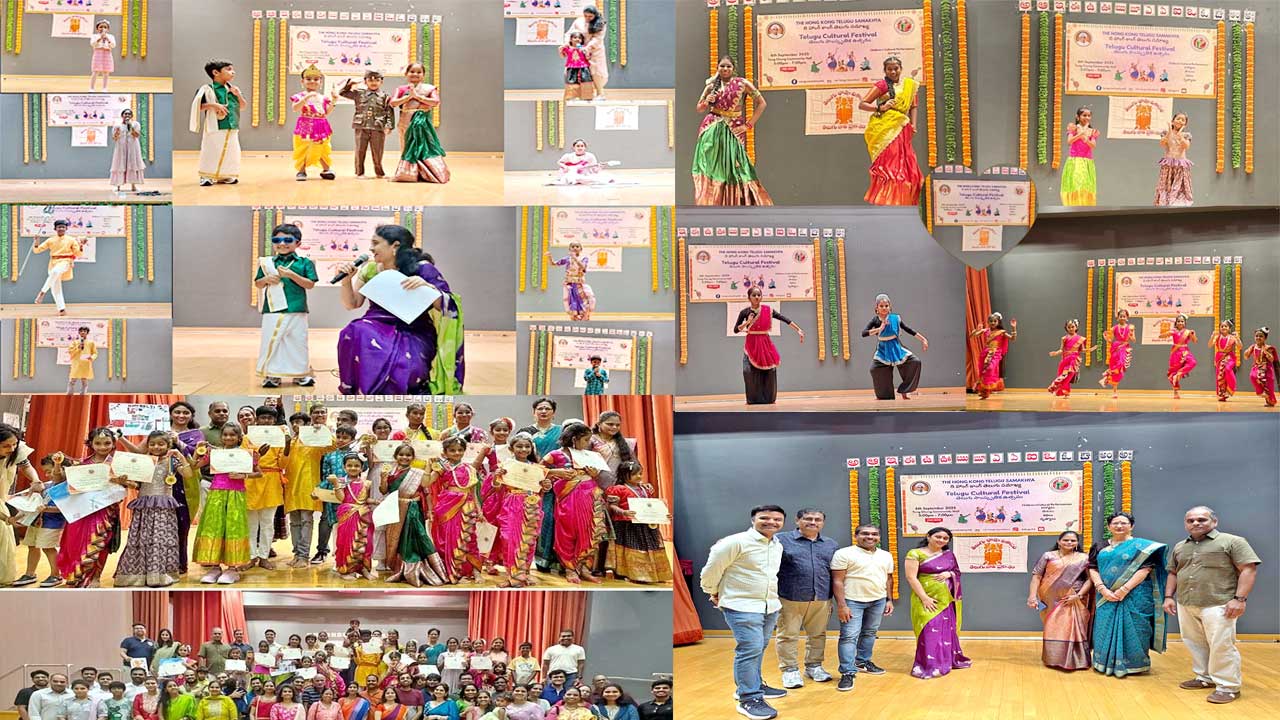
The Hong Kong Telugu Federation recently commemorated Gidugu Ramamurthy’s birthday with a cultural festival. Jaya Peesapati, a founding member, highlighted the significance of learning Telugu while explaining Gidugu’s contributions. Children performed classical, semi-classical, folk, and Tollywood songs and dances, showcasing Telugu language, culture, and heritage. Poetry recitations and storytelling activities were also part of the celebrations.
Additionally, a painting competition was held for children. The Federation emphasized its long-standing commitment to nurturing children’s hobbies and artistic talents, offering Telugu language classes on weekends for nearly twenty years. Members of the executive committee were acknowledged for their efforts in organizing the event, and children, along with their parents, were congratulated for their enthusiasm in preserving and promoting the Telugu language.