Annapolis, Maryland, USA: The American Physical Society (APS) has honoured these researchers for their groundbreaking contributions across multiple areas of physics.
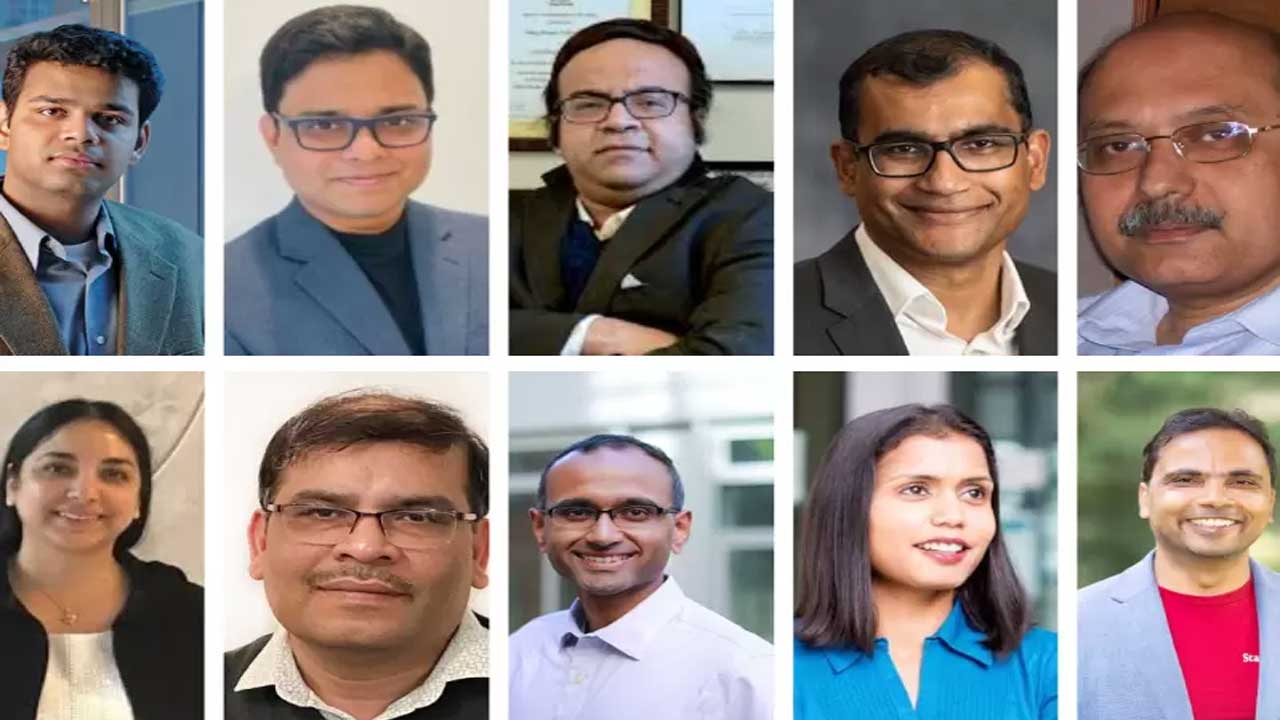
For 2025, ten scientists of Indian origin have been selected as Fellows of the American Physical Society, a prestigious recognition that highlights outstanding contributions to the field of physics. The fellowship is awarded to APS members who have made significant original research contributions or provided distinguished service to the scientific community.
As stated by APS, “Fellowship is granted only to members who have advanced physics through independent, original research or rendered notable service to the scientific cause.” The society further emphasised that this recognition “acknowledges excellence in physics and honours contributions to the physics community.”
The APS Fellowship is a peer-reviewed process in which members nominate colleagues based on their research achievements. Nominations include detailed citations, recommendation letters, and supporting documentation. Divisional committees review the nominations, and selections are finalised by the APS Council. Each year, fewer than 0.5% of APS members receive this honour.
The 2025 cohort includes scientists from premier universities and laboratories in the United States and India. Their research covers diverse fields, including quantum materials, astrophysics, biological physics, and data-driven science.
Ritesh Agarwal from the University of Pennsylvania was recognised by the APS Division of Materials Physics “for pioneering advancements in materials science through engineering novel electronic and photonic materials, integrating quantum geometry and bandstructure topology with precisely defined local defects, and characterising their properties using innovative nonlinear photogalvanic spectroscopies.”
Agarwal’s work has earned recognition from the National Science Foundation and the Office of Naval Research. He is noted for blending fundamental physics with practical materials design
Kamal Choudhary of Johns Hopkins University was honoured by the Topical Group on Data Science “for foundational contributions to data-driven materials discovery, including developing the JARVIS infrastructure and machine learning tools that integrate classical, quantum, and AI methods.”
Siddhartha Das from the University of Maryland received recognition from the Division of Polymer Physics “for fundamental discoveries concerning the behaviour of polyelectrolyte brushes and liquid transport in nanochannels grafted with these brushes.”
Karthik Duraisamy of the University of Michigan, Ann Arbour, was acknowledged “for pioneering work and leadership in applying machine learning to complex engineering fluid flows.”
From India, Rahul Pandit of the Indian Institute of Science, Bangalore, was named Fellow “for significant contributions to fundamental problems in statistical and nonlinear physics and for extensive service to the scientific community.”
Neelima Sehgal from Stony Brook University was recognised “for pioneering contributions to studies of the cosmic microwave background, particularly for conceptualising next-generation, high-resolution observatories.”
Sumanta Tewari of Clemson University was cited “for groundbreaking theoretical work on Rashba-coupled semiconductor-superconductor heterostructures as platforms for Majorana zero modes and topological quantum computing.”
Aaswath P. Raman from the University of California, Los Angeles, received recognition “for fundamental advancements in thermal photonics and radiative cooling, including demonstrating daytime radiative cooling for the first time.”
Padmini Rangamani of the University of California, San Diego, was named Fellow “for innovative work combining computational methods with realistic biological modelling to understand cell shape.”
Shambhu Ghimire from SLAC National Accelerator Laboratory was honoured “for pioneering studies of non-perturbative high-order harmonic generation in solids and for developing ultrafast spectroscopic techniques to probe material dynamics.”
Founded in 1899, the American Physical Society is one of the largest global organisations of physicists, committed to advancing knowledge through research, publications, and education. The APS Fellowship, a key part of its Honours Program, “celebrates the achievements of the international physics community” and promotes nominations that “reflect the broad spectrum of talent, distinction, and experience in the field.”