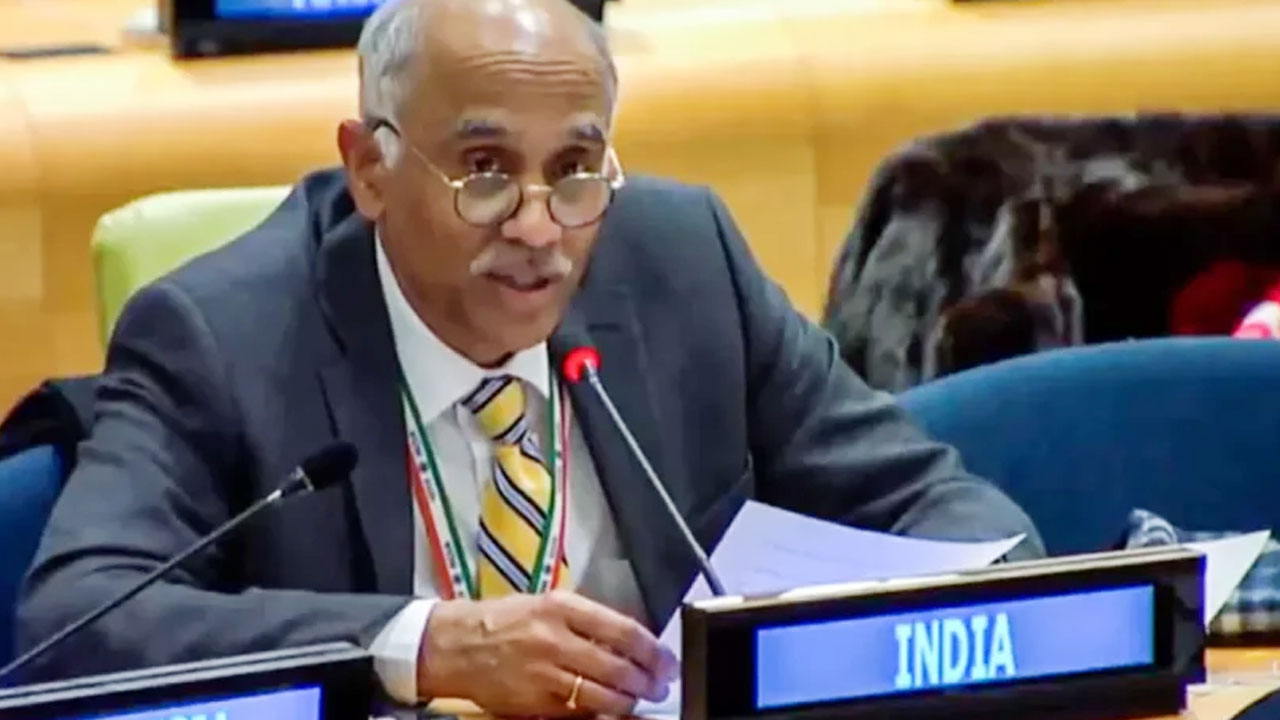
New York CIty, NY, USA: India has firmly opposed proposals seeking to expand only the non-permanent category of the United Nations Security Council (UNSC), asserting that such reforms would fail to address long-standing structural imbalances within the body's decision-making framework.
Addressing a meeting of the Intergovernmental Negotiations (IGN) process on Security Council reform on June 16, India's Permanent Representative to the United Nations, P. Harish, emphasized that any meaningful reform must include the expansion of permanent membership.
Harish stated that limiting reform to the non-permanent category would be "grossly inadequate" and would come close to failing the broader objective of creating a more representative Security Council.
The UNSC currently comprises five permanent members China, France, Russia, the United Kingdom, and the United States along with ten non-permanent members elected for two-year terms.
According to Harish, increasing only the number of non-permanent seats would leave the existing decision-making structure unchanged, allowing the five permanent members (P5) to retain their dominant role in Council affairs.
He noted that member states and negotiating groups have waited for decades for substantial reform and reiterated India's position that both permanent and non-permanent categories should be expanded simultaneously.
The remarks come as United Nations member states continue to differ on the future structure of the Security Council. The Uniting for Consensus (UfC) group, led by Italy and including Pakistan among its members, has consistently opposed the creation of additional permanent seats and instead advocates expanding only the non-permanent category.
Without directly naming the group, Harish criticized what he described as efforts by supporters of the status quo to slow progress in the reform process. He cautioned against using procedural principles as obstacles to meaningful negotiations.
India also renewed its call for text-based negotiations, urging the co-chairs of the IGN process to prepare a formal negotiating document supported by clear timelines and milestones.
Harish stressed that the IGN process should follow the established practice of other United Nations negotiations, which are typically conducted on the basis of agreed texts.
Reaffirming India's long-standing position, he argued that expanding permanent membership would make the Security Council more reflective of contemporary geopolitical realities and improve representation within the United Nations' most influential body.
He further criticized portions of the "Elements Paper" prepared by the IGN co-chairs, particularly suggestions that the concept of permanent membership requires additional clarification.
Referring to Article 23 of the UN Charter, Harish said the distinction between permanent and non-permanent members is already clearly defined and does not require further interpretation.
India, alongside Brazil, Germany, and Japan under the G4 grouping, has long advocated for permanent membership in an expanded Security Council as part of comprehensive UN reform efforts.