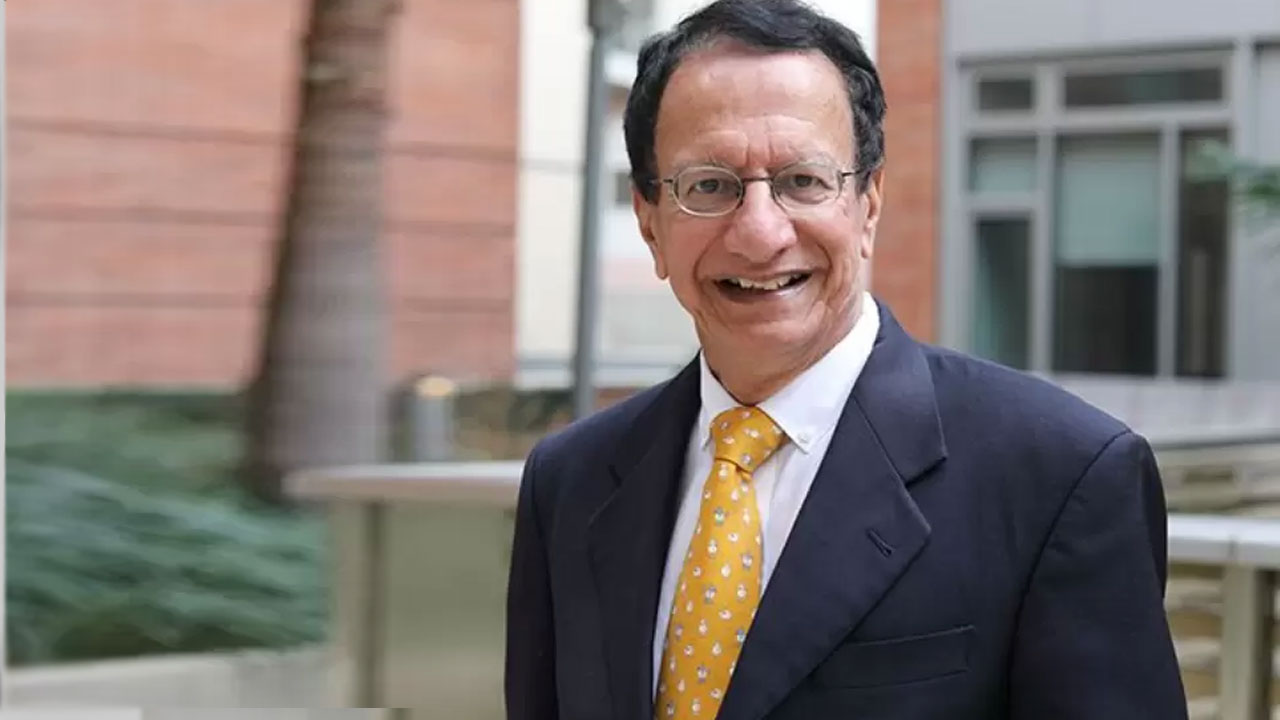
Los Angeles, California, USA: Renowned physicist Chandrashekhar Joshi, of Indian origin, has been selected as the first recipient of the Mukund Padmanabhan Term Chair in Excellence at the UCLA Samueli School of Engineering.
This appointment honours Joshi’s long-standing impact on plasma physics and accelerator science and formally introduces one of two endowed term chairs created through a generous US$500,000 contribution from UCLA alumnus Mukund Padmanabhan.
Ah-Hyung “Alissa” Park, dean of engineering and holder of the Ronald and Valerie Sugar Deanship, stated that Joshi’s research is expected to accelerate progress in plasma-based particle accelerators and compact light technologies, helping make these systems more compact, widely available, and cost-effective.
With more than four decades of groundbreaking work in experimental plasma physics, Joshi currently heads UCLA’s Plasma Accelerator Group. His research centers on designing advanced, high-energy accelerator technologies capable of producing efficient and compact particle beams for cutting-edge scientific applications.
Over the course of his career, Joshi has published more than 600 peer-reviewed scientific papers and has earned several prestigious accolades, including the James Clerk Maxwell Prize, the Marie Curie Award and Medal, and the Gothenburg Lise Meitner Award. He became a member of the U.S. National Academy of Engineering in 2014 and was inducted as a foreign fellow of the Indian National Science Academy in 2025.
Beyond research, Joshi has made significant contributions to education and mentorship. He has supervised 35 doctoral candidates, initiated an undergraduate Fast Track honors program, and was recognized with the Engineering Educator of the Year Award for his dedication to teaching and academic leadership.
Following the completion of his doctoral studies, Joshi served as a research associate at Canada’s National Research Council from 1978 to 1980. He received his Ph.D. in applied physics from the University of Hull in the United Kingdom in 1978, after earning a bachelor’s degree in nuclear engineering from the University of London in 1974.