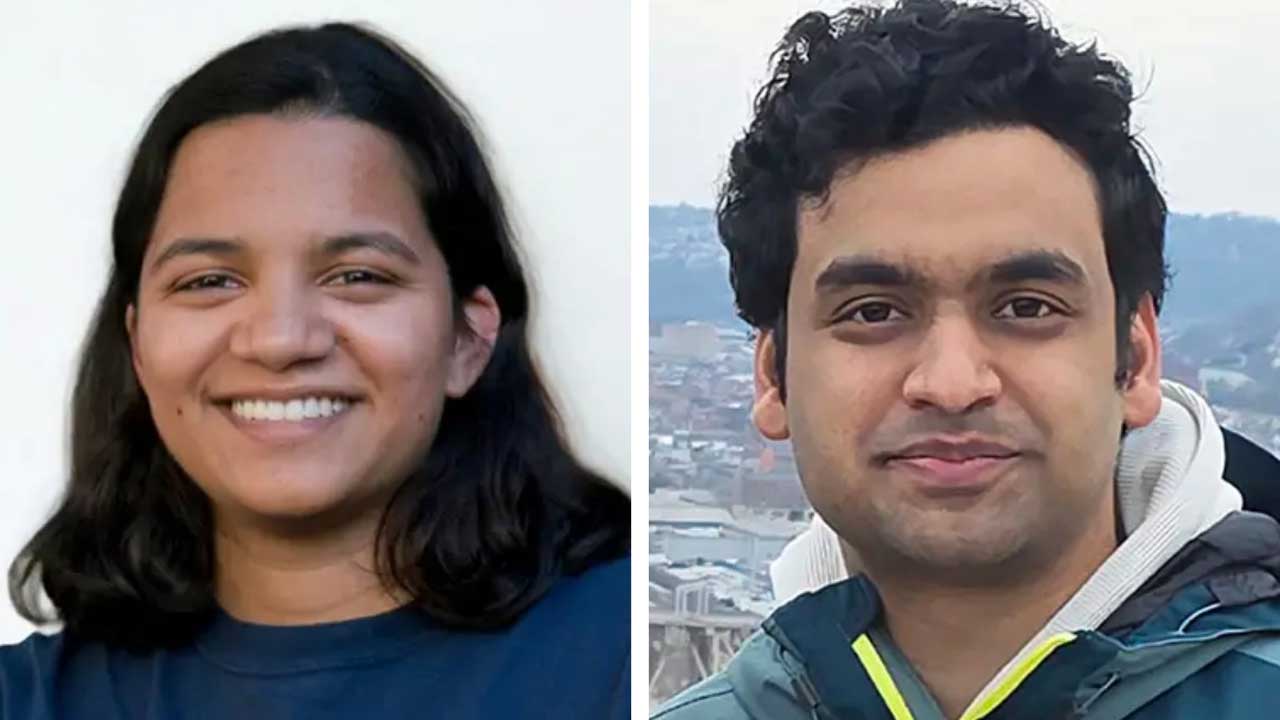
Pittsburgh, Pennsylvania: Two Indian-origin doctoral students at Carnegie Mellon University (CMU), Leena Mathur and Pranjal Aggarwal, have been awarded the SoftBank Group–Arm Fellowship to advance their research in artificial intelligence. They are among eight CMU Ph.D. students chosen for this prestigious program, which covers tuition, research costs, and provides stipends to support work in AI and human collaboration.
Mathur, a Ph.D. candidate at CMU’s Language Technologies Institute (LTI), has received a two-year fellowship. Her research focuses on building socially intelligent AI systems—developing algorithms that allow robots to understand human intent through speech and gestures. These innovations have promising applications in areas such as healthcare and everyday human–robot interaction.
Aggarwal, also from LTI, has been awarded a one-year fellowship. His work centers on creating autonomous computer-use agents capable of navigating digital environments like software platforms and scientific tools. His goal is to design self-improving AI systems that not only solve problems but also generate new challenges—paving the way for more open-ended and economically impactful AI applications.
The fellowships are part of CMU’s broader $110 million collaboration with Keio University in Japan, launched in 2024 with support from universities, government, and industry partners. This initiative explores cutting-edge AI research in fields such as robotics for home use, reducing errors in large language models, and AI-driven biomedical discovery.
Earlier this year, SoftBank Group Corp. and Arm committed $15.5 million to CMU to strengthen this collaboration and fund the fellowship program. The awards focus on four key research areas: multimodal and multilingual learning, embodied AI for robotics, autonomous AI–human symbiosis, and life sciences applications.
Expressing gratitude for the support, Martial Hebert, dean of CMU’s School of Computer Science, said the fellowships will empower students to push the boundaries of AI. “This program will help harness AI to drive discoveries in multimodal learning, robotics, autonomy, and life sciences,” he noted, adding that it will also encourage transformative research and foster industry partnerships to unlock AI’s full potential.