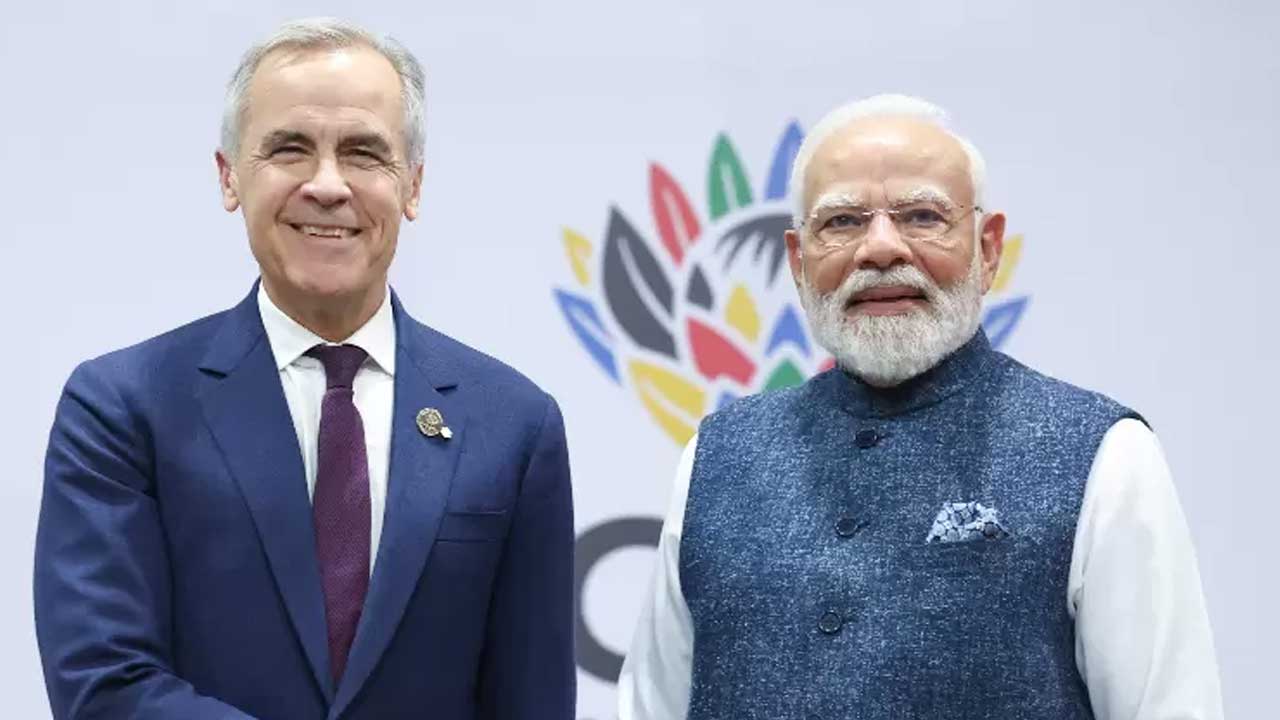
Ottawa, Canada: India and Canada took significant steps toward repairing their strained diplomatic ties on November 23, as Prime Minister Narendra Modi and Canadian Prime Minister Mark Carney agreed to begin negotiations on a broad trade agreement. Their meeting, held on the sidelines of the G20 Summit in Johannesburg, marked a clear attempt to restart bilateral cooperation.
Both leaders noted the renewed “positive momentum” in relations since their previous interaction at the G7 Summit in Kananaskis in June, pointing to the updated framework for collaboration released by Canadian foreign ministers in October.
Efforts to normalise relations have been underway since both countries reinstated their high commissioners in August 2025. The upcoming Comprehensive Economic Partnership Agreement (CEPA) is expected to be wide-ranging, covering sectors such as goods, services, investment, agriculture, agri-food products, mobility, digital trade, and sustainable development, according to a joint statement.
Modi and Carney expressed optimism that the agreement could serve as a strong economic pillar, potentially boosting two-way trade to nearly $70 billion by 2030. The renewed push follows the 7th Ministerial Dialogue on Trade and Investment held in New Delhi on November 13, where officials laid the foundation for restarting formal negotiations. India is already Canada’s seventh-largest trading partner, with bilateral trade touching $30.9 billion in 2024.
The leaders also agreed to increase diplomatic staffing in both nations, citing rising consular activity and the need to support growing people-to-people links. Canada highlighted that this expansion will also involve “reciprocal knowledge transfer,” reflecting close connections in academics, mobility programs, and immigration. India continues to be Canada’s largest source of international students, with nearly 392,810 Indian students holding study permits in 2024, and Canada is home to over 1.8 million residents of Indian origin.
Carney also noted progress in bilateral law enforcement cooperation, an area that has drawn attention due to past tensions. Both sides reiterated the importance of steady high-level communication, more frequent ministerial visits, and expanded engagement with businesses.
The CEPA discussions will proceed within the broader framework of the long-standing India–Canada relationship. Since 2018, the two countries have formally recognised their ties as a “Strategic Partnership,” supported by regular ministerial dialogues in areas such as foreign policy, finance, energy, and trade. Additional working groups collaborate on subjects including counter-terrorism, agriculture, education, and science and technology.
Science and technology have consistently been a strong link between the two nations. The bilateral science and technology agreement signed in 2005 continues to promote cooperation in health research, mobility for scientists, clean technologies, nanotechnology, and infrastructure development. The latest meeting of the Joint Science and Technology Coordination Committee in Ottawa in 2022 reaffirmed plans to deepen innovation-focused cooperation.
Trade remains a major driver of the relationship. In 2024, Canada exported $5.3 billion worth of merchandise to India, including vegetables, mineral fuels, fertilizers, paper, wood pulp, and related products. India’s exports to Canada increased to $8 billion, led by pharmaceuticals, electronics, machinery, metals, gems, and steel products. Canada also maintains a strong advantage in services trade, exporting $16.1 billion worth of services compared with $3.5 billion imported from India.
Air connectivity between the two nations has improved as well. The upgraded Air Transport Agreement allows both countries' airlines to operate unlimited weekly flights between key cities, encouraging more tourism, business trips, and student travel.
Looking ahead, Modi invited Carney to visit India in early 2026, which Carney accepted. This will be the first stand-alone visit by a Canadian prime minister since relations began warming earlier this year.
The November 23 meeting, held amid the busy diplomatic environment of the Johannesburg summit, signaled a strong joint intent to stabilise the relationship—one built on shared economic goals, extensive community linkages, and an expanding Indo-Pacific outlook.