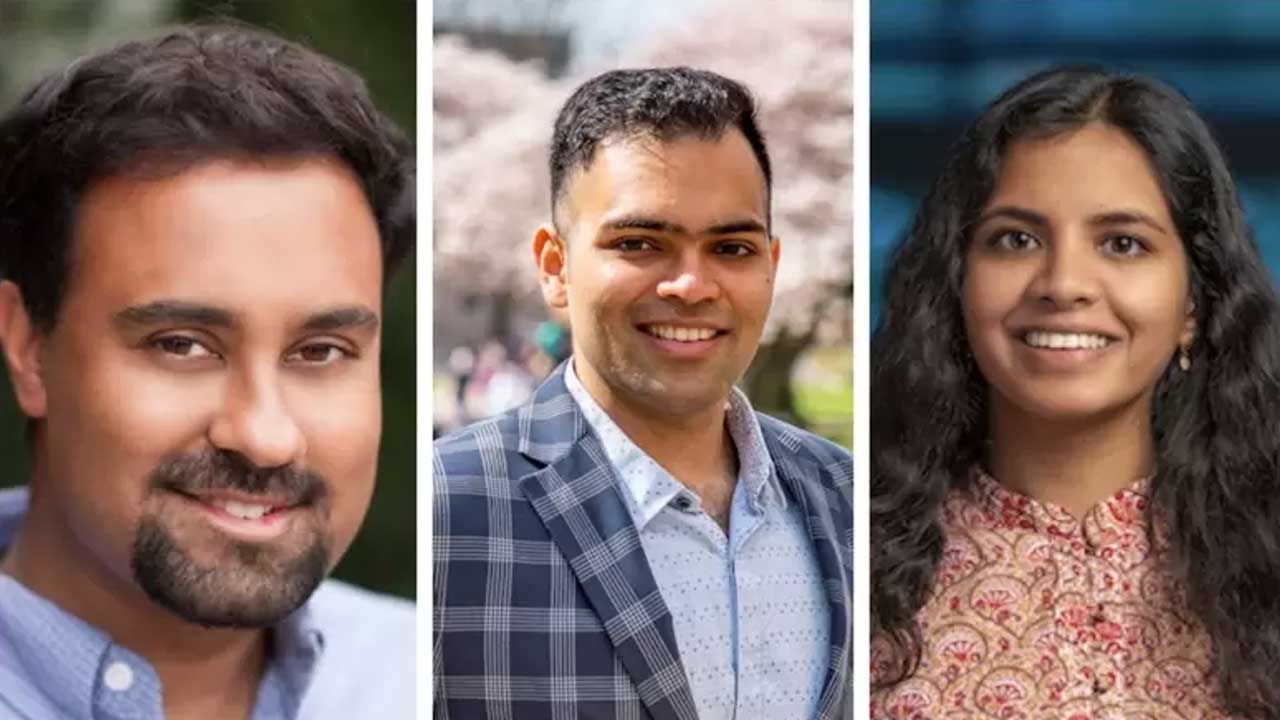
Philadelphia, Pennsylvania, USA: Three Indian-origin researchers — Surya Ganguli from Stanford University, Krishna Pillutla from IIT Madras, and Surbhi Goel from the University of Pennsylvania — have been honoured with the 2025 AI2050 Fellowships by Schmidt Sciences. They are among 28 global scientists chosen to share over $18 million in grants to advance research that ensures artificial intelligence serves humanity responsibly.
The fellowship program includes 21 early-career researchers and 7 senior fellows, each receiving funding for 3 years. Their projects address critical areas such as explainable AI, data privacy, and the dependability of conversational systems.
Surya Ganguli, a professor of applied physics at Stanford and associate director of the university’s Human-Centred AI Institute, has been selected as a senior fellow. His research focuses on building scientific principles for transparent and trustworthy AI by examining how large language and generative models reason and create. Ganguli’s lab is developing analytical frameworks to better interpret the creativity and logic behind these systems, aiming to make them more reliable and explainable.
A recipient of the Sloan Fellowship, Simons Investigator Award, and Schmidt Science Polymath Award, Ganguli’s current work blends neuroscience, control theory, and artificial intelligence to explore how AI can enhance itself through recursive learning and feedback.
Krishna Pillutla, an assistant professor at the Indian Institute of Technology Madras and lead researcher at the Centre for Responsible AI, has been named an early-career fellow. His research is centred on creating privacy-preserving and robust AI models, particularly for use in sensitive domains such as healthcare and finance. Through the AI2050 grant, he aims to design techniques that protect confidential data while maintaining strong model performance.
Surbhi Goel, an assistant professor at the University of Pennsylvania, was also selected as an early-career fellow. Her research in theoretical computer science and machine learning seeks to make conversational AI systems more reliable and safer. Goel’s project applies mathematical frameworks to identify and prevent unsafe or erroneous AI behaviour during human interactions.
“AI’s potential to improve the world is still vastly underestimated,” said Eric Schmidt, co-founder of Schmidt Sciences. “The AI2050 Fellowship was created to transform that potential into impact by empowering the researchers who are building a more secure and resilient future.”
Established in 2022, the AI2050 program now supports 99 fellows across 42 institutions in eight countries. The initiative aims to foster collaboration among scientists and promote the development of AI that is trustworthy, transparent, and beneficial to society.